


Denise Gaskins' Playful Math
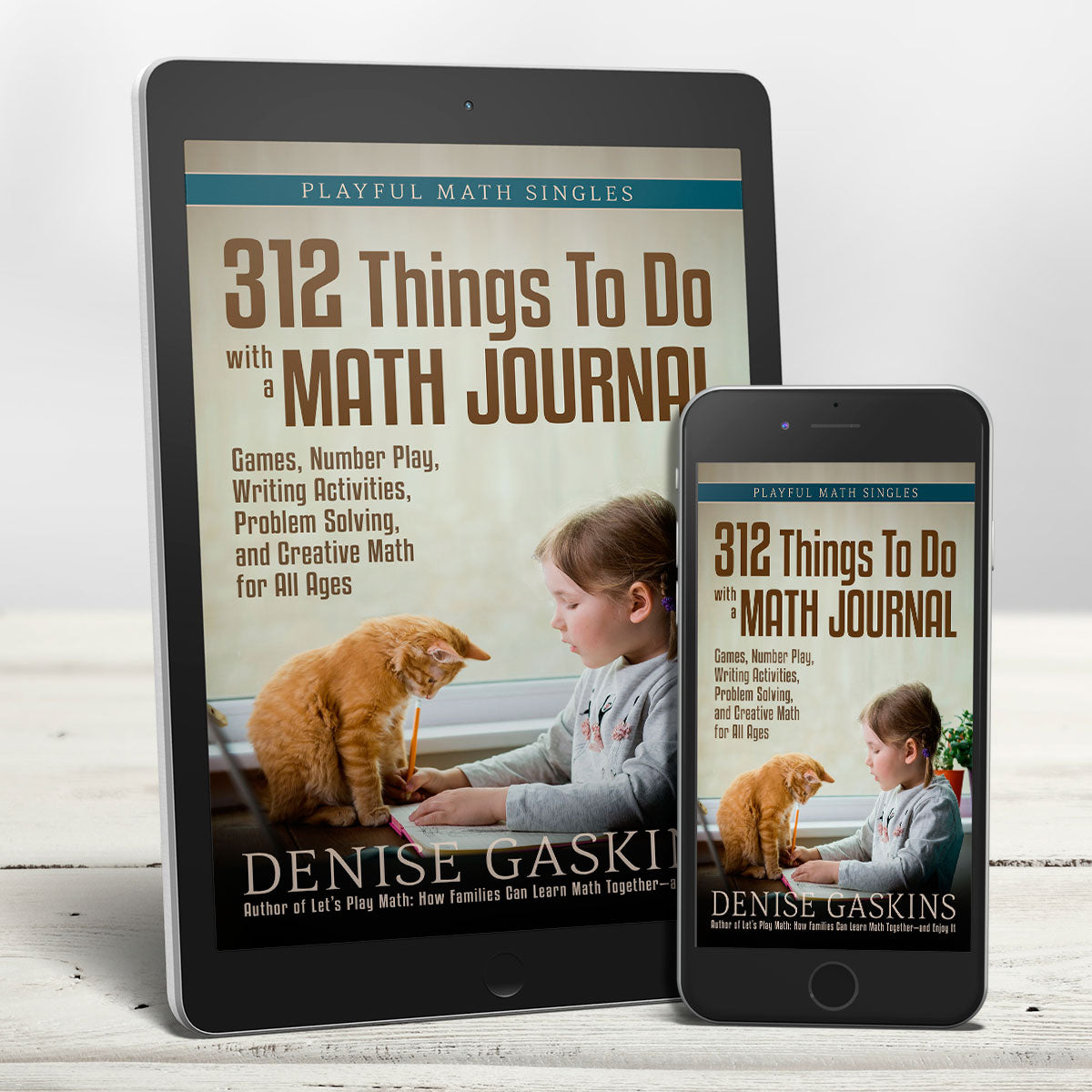
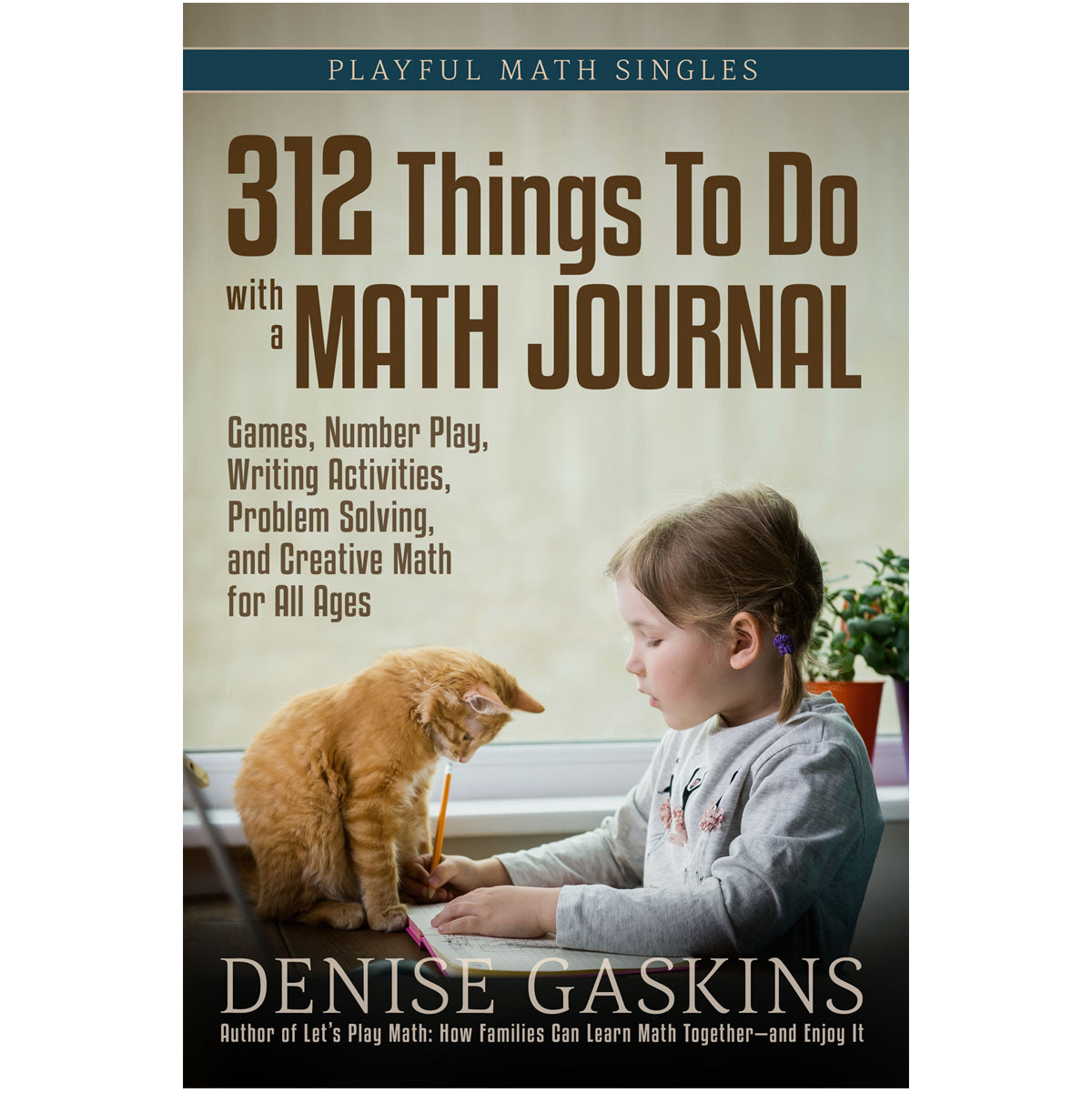
312 Things To Do with a Math Journal (EBOOK)
312 Things To Do with a Math Journal (EBOOK)
Couldn't load pickup availability
Games, Number Play, Writing Activities, Problem Solving, and Creative Math for All Ages
Are you looking for new ways to help your children learn math?
In a math journal, children explore their own ideas about numbers, shapes, and patterns through drawing or writing in response to a question.
Journaling encourages students to develop a rich mathematical mindset. Students begin to see connections and make sense of math concepts. They grow confident in their ability to think through new ideas.
312 Things To Do with a Math Journal includes number play prompts, games, math art, story problems, mini-essays, geometry investigations, brainteasers, number patterns, research projects, and much more. These activities work at any grade level, and most can be enjoyed more than once.
Pick up a copy of 312 Things To Do with a Math Journal and begin your family’s math journaling adventure today.
* * *“Denise’s books are always the first math books I recommend to parents. I have used them both with co-ops and at home.”
—Casey Ogg Maupin, homeschooling parent
Download a PDF preview file.
* * *
FORMAT: You get both a DRM-free EPUB file (for reading on your phone or ebook reader) and a PDF (for reading on a tablet).
FAQ: HOW IS AN EBOOK DIFFERENT FROM A PRINTABLE ACTIVITY GUIDE?
FAQ: HOW IS AN EBOOK DIFFERENT FROM A PRINTABLE ACTIVITY GUIDE?
The ebooks are written to be read. They include more inspiration, background information, and teaching tips, but do NOT include printable student pages.
You can think of the ebooks as a "teacher's manual" for their related printable activities.
The printable activity guides include brief teacher instructions, but the focus is on the student handout pages, making the activities easy to use in a classroom or homeschool. Many of the printable guides also include math journaling prompts and decorated pages for student writing.
Ebooks come in two formats: DRM-free EPUB file (for reading on your phone or ebook reader) and a PDF (for reading on a tablet). The activity guides come in printable PDF format only.
Either type can stand alone, though we believe they work better together. If you're on a tight budget, the ebook is often the better deal.
FAQ: HOW DO I GET MY EBOOK?
FAQ: HOW DO I GET MY EBOOK?
Ebooks are delivered instantly by link in your confirmation email (and as a backup, also by email from our delivery partner, BookFunnel).
(If your purchase includes a printable companion file, such as the Math You Can Play gameboards, the download link are not part of the BookFunnel ebook download.)
FAQ: HOW CAN I READ MY EBOOK?
FAQ: HOW CAN I READ MY EBOOK?
You can read your DRM-free ebook on any e-reader (Amazon, Kobo, Nook), or on your phone, tablet, or computer. You can also use the free BookFunnel app.
FAQ: CAN I RETURN IT FOR A REFUND?
FAQ: CAN I RETURN IT FOR A REFUND?
Ebooks, audiobooks, and printable activities are delivered immediately by electronic file download. They cannot be returned.
The only exception is for duplicate orders. If you accidentally purchase the same item twice, contact us immediately to get the second order refunded.
Share
- 5 stars: 4 (100%)
- 4 stars: 0 (0%)
- 3 stars: 0 (0%)
- 2 stars: 0 (0%)
- 1 star: 0 (0%)
I enjoy appreciate the way the book is structured, making it easy to find something that connects with other maths resources being used or other subjects entirely! It is simple to adapt many of the activities for a range or primary and intermediate ages, and I can see that older kids (and adults!) as well would get so much out of using these prompts to deep dive into areas of interest and curiosity. Thank you!
I had never thought about maths journaling before, but I plan to try out some of these ideas.An interesting read.
This is a fresh easy to look at math and how to solve everyday problems. It is not drill and kill method of route memorization. It reminds me strongly of the Charlotte Mason theory of learning. (See more about her learning/ teaching style) I do not know if that was the author’s intent or not. I also enjoyed the break down of different skills to focus on. I would use this with homeschooled children or supplement in a classroom.I received a free copy of this book to review.
I really think this is fantastic! You could just about make a class out of all these great ideas to work with mathematics and help children to grasp concepts with a fun approach.Learning simple math can be boring and challenging for many and these ideas give them a chance to explore and think instead of just remembering how certain procedures are carried out. I would love to see more of this in our current curriculums!