


Denise Gaskins' Playful Math
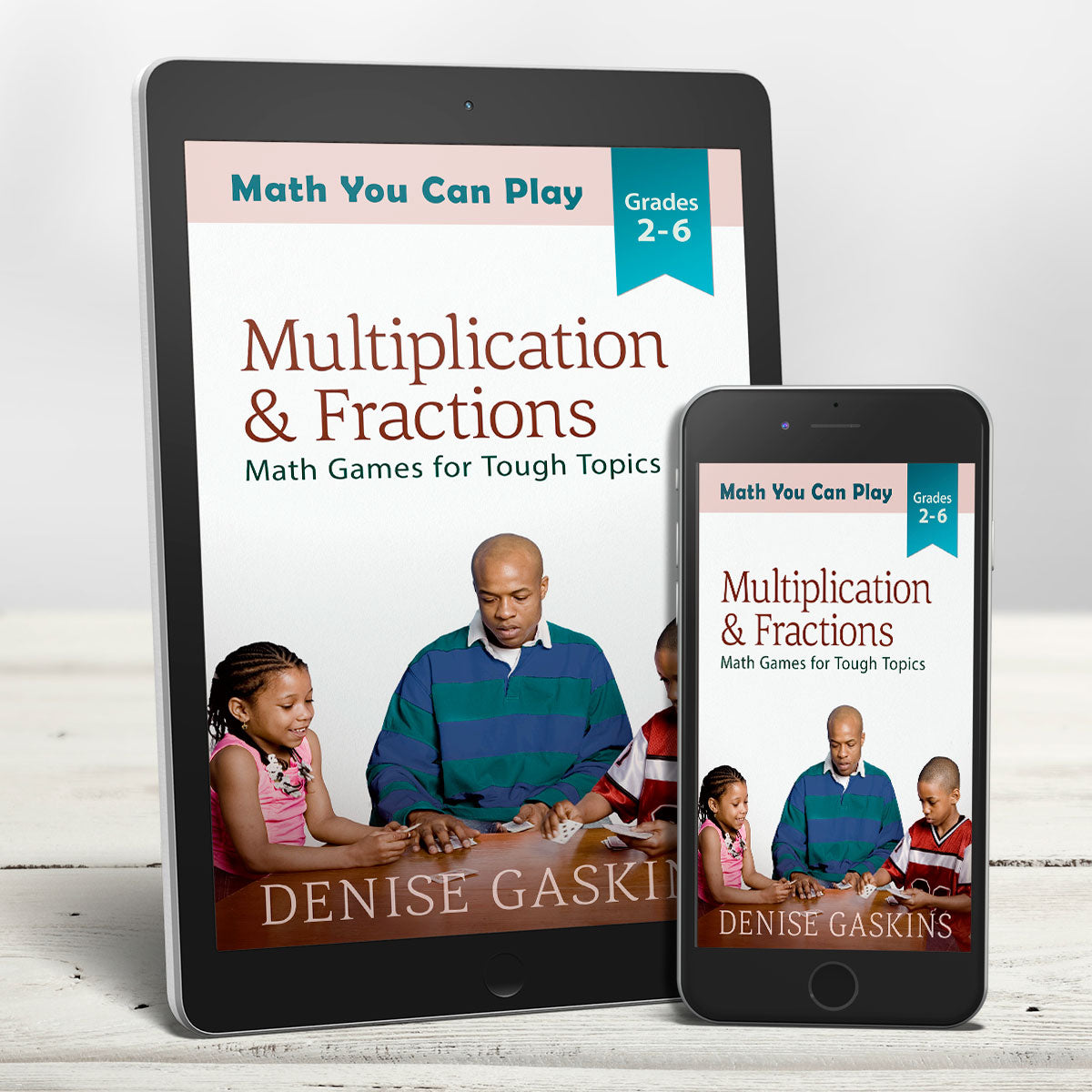
Multiplication & Fractions (EBOOK)
Multiplication & Fractions (EBOOK)
Couldn't load pickup availability
Math Games for Tough Topics
Rescue your child from math phobia — by playing games!
Multiplication & Fractions features 25 kid-tested games. Chapters include:
- Mathematical Models: Learn to picture multiplication and fractions in a way that supports your child’s comprehension.
- Conquer the Times Tables: Enjoy practicing the math facts until correct answers become automatic.
- Mixed Operations: Give mental muscles a workout with games that require number skills and logical thinking.
- Fractions and Decimals: Master equivalent fractions, work with decimal place value, and multiply fractions and decimal numbers.
“These areas are the first major stumbling point for students in their math studies. The sequencing in the book will help kids develop a strong foundation. Kids (and parents!) find these games fun. I’ve been field testing math games for the last 18 months and keep seeing how engaged kids get when playing math games.”
—Joshua Greene, Three J’s Learning blog
Math games prevent math anxiety. Games pump up your child’s mental muscle, reduce the fear of failure, and generate a positive attitude toward mathematics.
So what are you waiting for? Clear off a table, grab a deck of cards, and let's play some math!
* * *
Download a PDF preview file.
* * *
FORMAT: You get both a DRM-free EPUB file (for reading on your phone or ebook reader) and a PDF (for reading on a tablet). Purchase also includes the bonus 44-page PDF Multiplication & Fraction Printables companion file featuring two decks of mathematical model playing cards, plus hundred charts and game bords.
FAQ: HOW IS AN EBOOK DIFFERENT FROM A PRINTABLE ACTIVITY GUIDE?
FAQ: HOW IS AN EBOOK DIFFERENT FROM A PRINTABLE ACTIVITY GUIDE?
The ebooks are written to be read. They include more inspiration, background information, and teaching tips, but do NOT include printable student pages.
You can think of the ebooks as a "teacher's manual" for their related printable activities.
The printable activity guides include brief teacher instructions, but the focus is on the student handout pages, making the activities easy to use in a classroom or homeschool. Many of the printable guides also include math journaling prompts and decorated pages for student writing.
Ebooks come in two formats: DRM-free EPUB file (for reading on your phone or ebook reader) and a PDF (for reading on a tablet). The activity guides come in printable PDF format only.
Either type can stand alone, though we believe they work better together. If you're on a tight budget, the ebook is often the better deal.
FAQ: HOW DO I GET MY EBOOK?
FAQ: HOW DO I GET MY EBOOK?
Ebooks are delivered instantly by link in your confirmation email (and as a backup, also by email from our delivery partner, BookFunnel).
(If your purchase includes a printable companion file, such as the Math You Can Play gameboards, the download link are not part of the BookFunnel ebook download.)
FAQ: HOW CAN I READ MY EBOOK?
FAQ: HOW CAN I READ MY EBOOK?
You can read your DRM-free ebook on any e-reader (Amazon, Kobo, Nook), or on your phone, tablet, or computer. You can also use the free BookFunnel app.
FAQ: CAN I RETURN IT FOR A REFUND?
FAQ: CAN I RETURN IT FOR A REFUND?
Ebooks, audiobooks, and printable activities are delivered immediately by electronic file download. They cannot be returned.
The only exception is for duplicate orders. If you accidentally purchase the same item twice, contact us immediately to get the second order refunded.
Share

- 5 stars: 11 (100%)
- 4 stars: 0 (0%)
- 3 stars: 0 (0%)
- 2 stars: 0 (0%)
- 1 star: 0 (0%)
I love all of Denise Gaskins books so far, and Multiplication and Fractions was just what we needed to work on challenging concepts in a engaging and fun way. There's still a lot to the book that I haven't explored yet, but everything we've tried thus far has worked great. Math no longer causes tears or headaches!
I am excited to have a plan for how to make math more playful. My kids are loving it and that is such a huge win for us. It’s a healing balm for kiddos who are anxious about math!
Customer service is above and beyond excellent
If you need help with homeschooling math, please buy her book. She has games, books, and websites she recommends. This book has ideas to make math fun! Also great for kids who need hands-on learning as lot of the games are hands-on. I’ve also bought some of her other books because they have been so helpful!
I’m not gonna lie: I love games for school in theory, but I have a hard time following through – and even more so when there are a bunch of pieces and hard to follow rules. (I actually got another book with math games from a popular math curriculum, and I feel like I have to read the directions for the games several times before I really grasp it.)
I feel like as my kids have gotten older, I’ve tended to be less involved in their math education (whether because I’ve shifted some of it to my husband or to online). This is actually something that’s been a bit of a discouragement to me, as I really WANT to be involved, but to be very honest, sometimes it’s a little hard for me to keep up.
I honestly kind of thought that math games were something we could do in elementary school but not really much after that. BUT – I LOVE that I can play these games with middle and high schoolers! I also appreciate that the games are pretty straightforward and easy to understand for the most part, but they’re also fun – and more importantly, they cement the math in ways that drills don’t. I haven’t quite gotten how this works, but I think it also helps some of these seemingly abstract concepts to have a bit more anchoring in practicality.
Pros: Most games can be played with very simple materials – a deck of cards, some dominos or pencil and paper. Games pretty easy to understand and play – and FUN! No, like for real! Cons: Okay, fine, so I still have to read the instructions a few times to really get how to play, but I think that’s my English major brain digesting math. And at least I don’t want to get rid of the whole book, and I can pick up the game in 2-3 reads instead of 5-6 (no exaggeration. I shelved another book bc I just wasn’t getting it. Don’t judge.).
It's a great idea...but doesn't have as many word games as I was hoping. I thought it was all ideas of playing math with word games. But it uses a lot of 100's charts, playing cards or her own special set of downloadable cards. If you're tight on money, you could basically find all these games by doing a lot of internet searching. Same with the other book Math You Can Play. I'm still keeping them both though because it's a lot of ideas in a nice tidy book that we'll play here and there to keep math fun between our Math Mammoth worksheets (which are awesome by the way, coming from a homeschooled Saxon math girl that got straight A's and understood nothing).
This book is very useful to have on hand. If you have nothing planned that day or are feeling uninspired, just pick a game and explore. I appreciate the beginning of each chapter which provides helpful kernels for how to approach the topic - Illustrations, tips on mental math, excerpts that give perspective.
I have many math books, but none are like Gaskins’ which curate and assemble whats important for regular parents in the context of homeschooling!
-- Variations and scaffolding for each game is provided.-- The learning content is shown at the top of the page for each game. And please do skip as needed. I made the mistake of getting bogged down in the first section which is all about fraction model cards. Once I figured out to skip this whole section and find what fits us, the learning and fun took off.
When you were in school, did you have a problem learning the multiplication tables and studying fraction? These are two areas which are among the first major stumbling points for students in their math studies.
Multiplication and Fractions is the third book in Denise Gaskins’s series “Math You Can Play.” Book one is Counting and Number Bonds: Math Games for Early Learners, Grades PK-2, and book two is Addition and Subtraction: Math Games for Elementary Students, Grades K-4. In each of these, Sections I and III, which consist of setup information and math teaching tips, are each repeated to make sure the books can stand on their own.
Section II, after providing instructions on making multiplication and fraction playing cards, contains 25 math games divided up into four main divisions, with five to eight games each using simple household items such as playing cards, dominoes or dice, as well as several game boards available for free online. Some of them are based on well-known old games such as Fish, Concentration, War, Rummy, Tic-Tac-Toe, Twenty-Four, and Pickle. Others are newer ones developed by math teachers.
Gaskins quotes Sue VanHattum who wrote, “Most people like games, so that’s an easy place to begin. At first the games can be the sweetness that helps the math medicine go down. Over time perhaps you can find the sweetness in the math itself—in a problem that inspires you to work and struggle until you finally get it, just for your own satisfaction.”
Playing math games helps students not only to see mathematical exploration as fun and joyful, but also to gain a more thorough understanding of number concepts instead of having merely a collection of apparently unconnected facts that if they are lucky they can recall when needed. The emphasis is on using games for conceptual understanding, learning different mathematical models, flexibility in working with numbers, logic, problem solving, and generally the importance of mental math.
The author also quotes Ruth Beechick who said, “If you stay with meaningful mental arithmetic longer, you will find that your child, if she is average, can do problems much more advanced than the level listed for her grade. You will find that she likes arithmetic more. And when she gets to abstractions, she will understand them better.”
Get ready—get set—let’s play math!
I am so excited that this book is finally here! If you haven't come across Denise Gaskins' previous books (Counting and Number Bonds, and Addition and Subtraction), then you should know that she presents a way of learning math that may seem revolutionary to those raised with traditional memorisation and rote practice methods.
She argues that we should be able to see mathematical exploration as fun and joyful, the way we do with stories, pictures and music. She also points out the damage that bad teaching can cause, as children not only can become maths phobic but also fail to gain a real understanding of number, having instead merely a collection of apparently unconnected facts that if they are lucky they can recall when needed.
As well as general suggestions, the bulk of the book consists of a collection of games that can help with number sense, that is, real understanding of what multiplication and fractions mean and how they work, as well as practice in the times tables. The games largely use simple household items such as playing cards, dominoes or dice, as well as several game boards available for free online.
One difference in this book is that she also provides two custom decks of cards to illustrate various ways of 'seeing' multiplication and fractions, as well as instructions to make your own if you prefer. I'd recommend the latter as I think it helps to really gain a thorough understanding of the concepts, but we've only used the printable ones so far and they've been great. My 9yo who has really struggled with the idea of multiplication loved pretending the images were tasty treats - arrays were chocolate bars, sets were cookies with chocolate chips. In just a few plays with this deck not only has her understanding improved but so has her self-confidence and impression of multiplication as fun rather than something to be afraid of.
The games are divided up into four main sections, with 5-8 games each, so there are plenty to try! We've also been enjoying 'Galactic War' (including my 4 year old!) and my oldest loves playing "Times-Tac-Toe" and "The Product Game" both of which have given her lots of practice in multiplication strategies and remembering some of those elusive facts. I'm really looking forward to exploring the rest of the games.
I'd recommend this book to anyone who wants to impart a love of maths to their kids, to anyone who loves games, and to anyone looking to help kids with these tricky concepts in an enjoyable way that builds real mathematical understanding.
I should note that I received a free review copy of the book, although if I hadn't I would have bought it anyway!
This book has so many great game ideas. I am both a homeschooling parent and at times a math teacher/tutor for other homeschoolers, and I look forward to using it more in both contexts. This book has many different games for different skill levels, including many that I've not seen before.
I appreciate the emphasis on conceptual understanding, use of different mathematical models, flexibility of working with numbers, mental math, and logic and problem solving.
One of my favorite things in this book are mathematical models card deck games. These cards present multiplication facts or fractions with several different visual models and you can use them to play common card games like War, Go Fish, Rummy, Concentration, etc. My 9yo and I had fun playing Go Fish with multiplication facts. I also enjoy the variations and house rules options offered after many of the games, as well as the history.
I'm a big fan of using games to learn math concepts and become proficient in mathematical functions, and this book is a fantastic addition to our treasure trove of math games. I love that there are so many different ones to try, and that we don't need any special equipment to play them. Everyday games that can be played anywhere, anytime while making math into a fun venture. A total win-win.